





















Pass This On
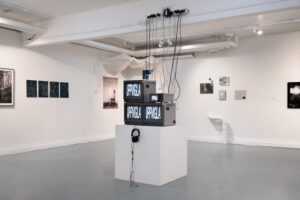
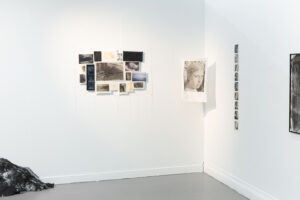
Welcome to the group exhibition Pass This On (2025) by the second year photography bachelor students at HDK-Valand. This show brings together a wide range of works exploring different themes, processes and approaches to photography today.
Presented by
Agnes Andersén Nebrelius, Amandine Duisant, Anne-Sofie Ø Petersen, Caroline Guldager Gardendal, Catharina Leth, Cornelia Hellgren Amerio, Daniela Tejada, Filippa Axelsson, Hannah Bjurhult, Hugo Aldén, Johan Frisk, Linus Örhn, Lukas Parkow, Martin Gleerup, Nerissa Björk, Rikke Mádi, Still Sam, Tilde-Elias Hamrén, Tuva Westerholm, Zenit Douglas
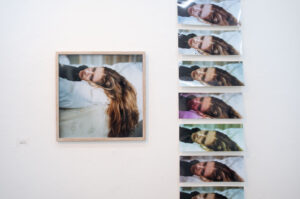
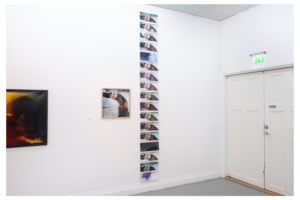
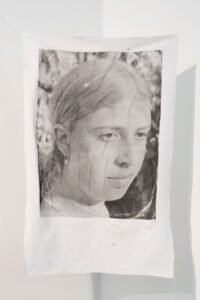
In Amandine, 13h Agnes Nebrelius explores photography as craftsmanship by documenting the time it takes to create a portrait, while simultaneously reflecting on the time it takes to know someone.
The project is an exploration on whether the time spent with a physical image can affect the personal relationship between two people
Materials: C-prints
Size: 45 x 45 cm. and testprints in various sizes
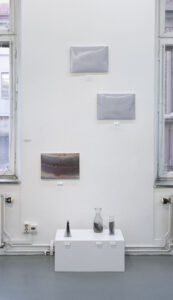
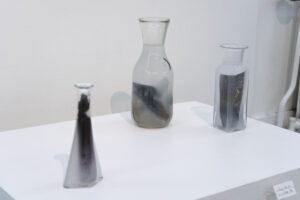
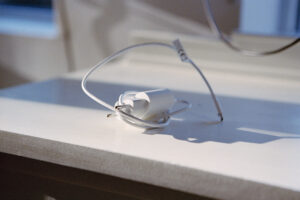
my everyday mess preserved is an attempt to conserve my daily life a little longer. The boring parts
of our routines and the leftovers they leave behind are worth remembering, or at least I believe so.
My conservation methods are not accurate and do not try to be so – the liquid will rot at some point,
and the prints will fade – but it will have extended the life of those memories for a bit.
Materials: Inkjet prints, lazer prints, glassware, water and coconut milk
Size: Prints: 29.7 cm x 42 cm, glassware: between 5 cm and 25 cm each
matter as imprint
matter as light
matter as trace, movement, and becoming
an inquiry into what we can shape, what we cannot shape – and what shapes us.
Materials: “Materie I-III” : Photogram C-prints, , Mounted on dibond. “Lysmaterie I-III”: Wooden light boxes, , with integrated LED lighting.
Size: 18 × 18 cm., 12 × 12 cm.
“An ethic, not an aesthetic” – Peter Reyner Banham
Æstetisk Brutalisme is an homage to the raw and rustic presence of the concrete that exists within our citywalls. Originally created as a simple and functional solution for inhabitation, brutalist architecture has now become its own aesthetic in the landscape. Often looked at as harsh and unpleasant to the eye, the square apartment blocks house a nostalgia and history that is forever preserved. Æstetisk Brutalisme challenges the way we perceive our environments and the elements we coexist with. The collages include images of nature found near the buildings, as well as objects from the specific areas. And…apartment blocks.
Materials: C-prints, Silver gelatin prints
home potential / bagged with ambitions / a truly pleasant experience explores the metropolis as a phenomenon and condition where construction is at center. Construction sites with unfinished structures, raw materials that create and shape a city, and combinations of natural and human-made objects that appear in the cityscape, all coming together as a constant background blur, where structures appear, disappear, and reappear.
The work is rooted in conflicting feelings about living in larger cities. It is a longing for connection and belonging to a place, however in a metropolis, constantly in a state of flux, finding connection between rapid urban expansion and the unpredictable nature of “for profit” city development creates a crevice between a sense of belonging and the physical space we live in.
Materials: Silver gelatine prints
Size: 48 x 30 cm, 24 x 30 cm.
Cornelia Hellgren Amerio (b.1998) investigate the delicate beauty and history of lace. Through the cyanotype process she transforms this brittle material, mixing the detailed craftsmanship with the bright blue light-sensitive method. The project focuses on the way modern society has used and changed crafts that originally were created and practiced by women, but are now made by machines.
Materials: Digital print, Cyanotype on aquarelle paper
Size: 70 x 100 cm., 29,7 x 42 cm., x6.
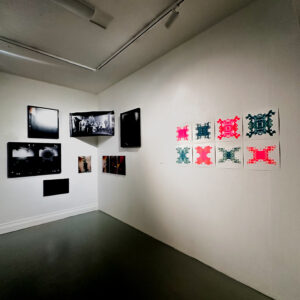
The series Disrupted Reflections transforms photographs of cows into kaleidoscopic structures that shift between figuration and abstraction. Each collage is printed twice in risograph, creating a dialogue between two chromatic worlds. Placed together, the prints reveal how identity changes through movement. These dual impressions expose a reality that mutates when displaced from familiar contexts, showing how meaning is reshaped by the place where it is perceived.
Materials: Risograph prints; Fluorescent pink & Orange inks, Teal & Yellow inks
Size: 29.7 x 29.7 cm.
Filippa Axelsson (b.1998) is a mixed material artist with her basis in photography.
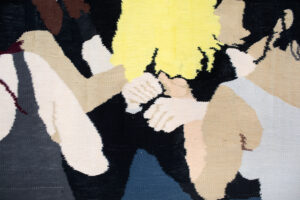
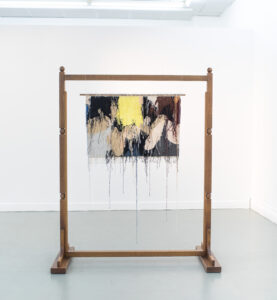
Axelsson is currently working on the project “Untitled snapshots” where she translates her own snapshots taken on film or digitally, into woven wallhung tapestries.
This practice allows her to explore how the fast paced and casual action of snapshot photography contrasts with the time-consuming and intricate craft of weaving.
Materials: 100% cotton yarn, warp yarn, photo taken with digital camera, Exhibited in a floorstanding woodfram
Size: 50 x 70 cm
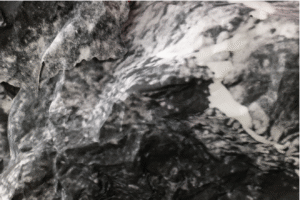
Och berget såg vi vittra by Hannah Bjurhult
During our lifetime we’ll never watch a mountain deteriorate. To see it, one would have to live to eternity. Though unobservable, it’s happening before our eyes and one could imagine what it’d be like if the mountain wasn’t there anymore. How we experience this deterioration without ever seeing it is in a way similar to our memories being formed. It’s awareness of the fact that the moment will pass, in a while it won’t be what it is now. It doesn’t change in an instant, it’s slow, inconspicuous and somehow the change is the only constant.
Materials: Liquid emulsion, digital print and laser cutting on fabric
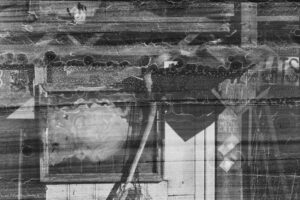
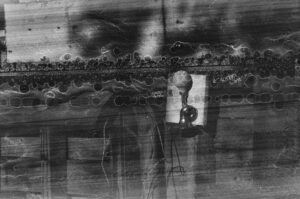
In the ongoing project Vid glömskans gräns Hugo Aldén approaches the dissolvement and merging of memories.
When visiting his childhood neighbourhood he found himself strolling through half-familiar paths. Trying to retrace images that he remembered. Conversations about old memories almost made them more blurry hearing someone else’s version of it. What happens to memories that are on the verge of being forgotten?
Aldén has since five years back suffered from retinal migraine which temporarily clouds his vision. These intrusions on his sight inspired the intrusions on the images in the darkroom and acts as a visualisation of memories in decay.
Materials: RC-print,C-print
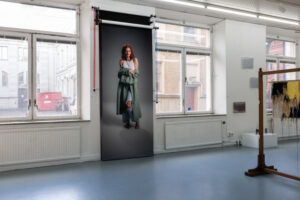
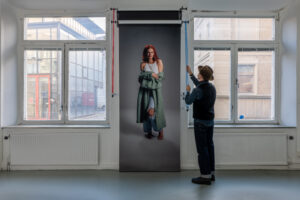
Johan Frisk explores light techniques and portrait photography in the studio. Working in collaboration with the persons in the images and making them a part of the project. The work looks at how they perceive themselves when depicted through the camera, and if this changes when different photographers or brands photograph them as models.
Are the images their own reflection, or a version of them crafted by the photographer?
Materials: Inkjet print on enhanced matte paper
Size: 110 x 300 cm.
Political violence is on the rise. A wave of right-wing radical boxing clubs are emerging all over the world, and when radical left-wing groups confront them, clashes are bound to happen. This violence occurs in broad daylight yet the motives of the attacks go unnoticed.
The work uses found footage from different groups that is actively being spread online, to showcase their group’s capacity for violence as a form of propaganda. The aim of the work is to show this violence in such a way, that it forces the viewer to confront this new wave of violence.
Materials: Video 5:09 min.
“Noise is disorderly sound, without purpose. As such it may be compared with disorderly or confused action – i.e. anarchy.” – R. Murray Schafer
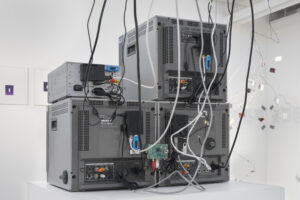
This project dives into the all more frequent populist rhetoric politicians use in order to sway the political narrative. The small tweaking of words and exaggerated terms allows for a hostile verbal terrain that constructs an us vs them mindset, how this legitimizes an increased authoritarian climate and a restrictive political landscape. The work consists of found footage from demonstrations in Sweden with written extracts and transcriptions taken from Swedish politicians.
Materials: 4x Crt monitors, found video, found text, (10:28), Sound work (20:07)
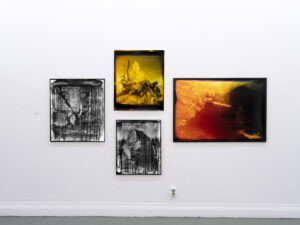
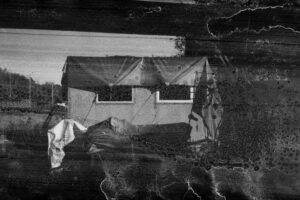
After Martin Gleerup (b.1992) saw a patch of clearcut forest, something happened. An affectionate place was created inside of Martin Gleerup. The feeling of seeing the forest mowed down stirred up emptiness and sorrow inside of Martin Gleerup.
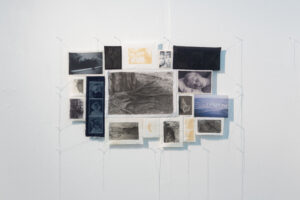
The last remaining details are in frame of the now desolate empty field. The tiled together crooked pictures with it’s polluted monochromatic color, the drippy, faded black and white pictures – arepresentation of the faint remains of a forest.
The alarming conceptualisation of humanity’s greed of things that were, things that are, and the future karma of things that have not yet come to pass
Materials: Silver gelatin prints, C-Prints
Size: 110 x78 cm., 64 x 60 cm., 68 x60 cm., 76 x 76 cm.
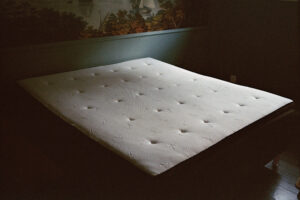
Last Days is a documentation of the final days in Björk’s family home — a home in the process of being dismantled ahead of a move to a distant place.
By looking closely at rooms and objects, she examines the last traces of her family members in the house, while simultaneously processing her own memories and separation from the place.
Materials: Inkjet prints
Size: 60 x 90 cm.
Rikke Mádi (b. 1997) explores how photographs of mountainous landscapes shape our collective visuality of these.
The photograph represents one moment, one point of view, one perspective. According to philosopher Jean Baudrillard, photographs end up becoming realities instead of representing them, thereby becoming simulacrums. How do these distance us from our surroundings and our capability of ‘seeing’ in a broader sense?
Working with archive material of mountains in Scandinavia, Mádi uses cutouts and details to disrupt the situated gaze of the original photographs. Printing on colored paper and shaping prints to seem like rocks the photographs are reformed and recontextualized creating awareness of constructed visualities and situated gazes. Can we imagine other ways of visualizing our surrounding landscapes?
By creating a simulacrum of an orogenic process, a mountain-building process, in different paper materials and photographic prints, Mádi explores how photographs shape reality as much as it can be a tool to deconstruct it.
Materials: Inkjet print on 220g Elle-Erre colored paper and paper sculptures
Size: Various sizes
Matterealism
What else might
materialise
when I let
the matter
of the subject matter
matter
in the process of
materialising
the latter?
Materials: Analog Photography developed with alternative processes, using the processed contents of the bucket
Tilde-Elias Hamrén is an artist and photographer whose work deals with themes such as trans joy, gender dysphoria and coming of age stories.
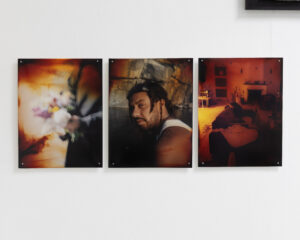
In This Body of Mine, they explore the lifelong companionship between mind and body and how it is complicated by gender dysphoria. When body and mind finally start to align, can this relationship begin to heal?
The work consists of three colour darkroom prints showing the body in a state of free fall – or perhaps floating upwards.
Through these images they paint a picture of pain and dysfunctionality, but also one of self love and reconciliation.
Materials: C-Prints in pine frames
Size: 3 x 30 x 40 cm.
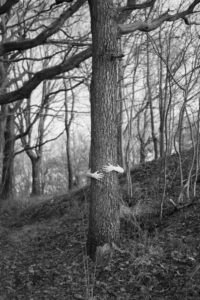
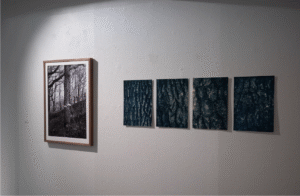
In Hud mot hud (skin to skin) Tuva Westerholm explores the relation between people and nature.
Westerholm’s work is inspired by the Japanese phenomenon Shinrin-yoku, nature bathing, focusing on sensory engagement to connect with nature.
Finding the connection to nature and finding the connection to yourself, your calm and your inner peace.
Many of Westerholm’s works center around stress related disease, more specifically, burnout syndrome.
Materials: Inkjet print, 4 cyanotypes tinted with coffee
Size: 50 x 70 cm., 4 x A3
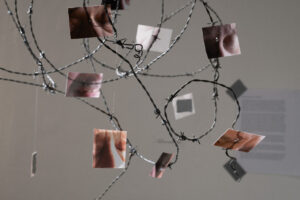
The patriarchy is inherently violent. In the work Att tala om våldet, To speak about the violence three men from different backgrounds and generations share their experience of violence correlated to their gender. Whilst they share their experiences, they are photographed.
The portraits are then hung in a tangle of barbed wire. Representing the complex structure of a gender system that perpetuates the violence.
Materials: Audio(18min), Barbed wire, Inkjet print on archival paper