SENSATIONAL SURFACE
What makes an image engage us to view it not only optically but bodily?
For as long as I can remember, I’ve had a very active mind and vivid imagination. I could easily zone out growing up, interacting with the world – trying to understand and sense it through my eyes. Like, for instance seeing a bird flying, I would imagine what that would feel like. How it must be one of the most liberating sensations. I could picture it so vividly that I almost experienced a sense of weightlessness.
I believe this has had an impact on the way I have consumed art throughout my life. I often found myself lingering longer at artworks that made me engage with it bodily rather than purely optically. Analyzing its surface, imagining how it would feel to touch it, or how it would smell. Substituting my nose, mouth and hands for my eyes, I could “feel” what I was seeing.
How can a photographic image give me a perceived sense of experienced reality?
In my practice I explore what I refer to as visual tactility, which describes a relational phenomenon that unfolds between image and spectator, where it becomes possible to “feel” an image through sight alone. This being attributed to a certain type of imagery that encourages a phenomenological way of seeing, rooted in sensory memory, allowing the viewer to imagine sensations such as touch, temperature, pressure, and movement although it is depthless, static and “untouchable”.
Haptic visuality – a key concept In Laura U. Marks’s book “The Skin of the Film Intercultural cinema, embodiment, and the Senses” speaks on a way of seeing where vision functions as touch. With it emphasizing the role surface, texture, proximity, and partial perception, play to encouraging bodily involvement rather than distanced observation. She writes: “In haptic visuality, the eyes themselves function like organs of touch” (Marks, 2000 s.162). This idea resonates strongly with my own experience of images that seem to demand closeness rather than distance. Images like these require time, attention, and bodily engagement to fully experience them – where meaning develops gradually, through sensation rather than instant recognition. When an image suggests texture, weight, or material resistance, I find myself recalling similar sensations from lived experience, completing the image through my body.
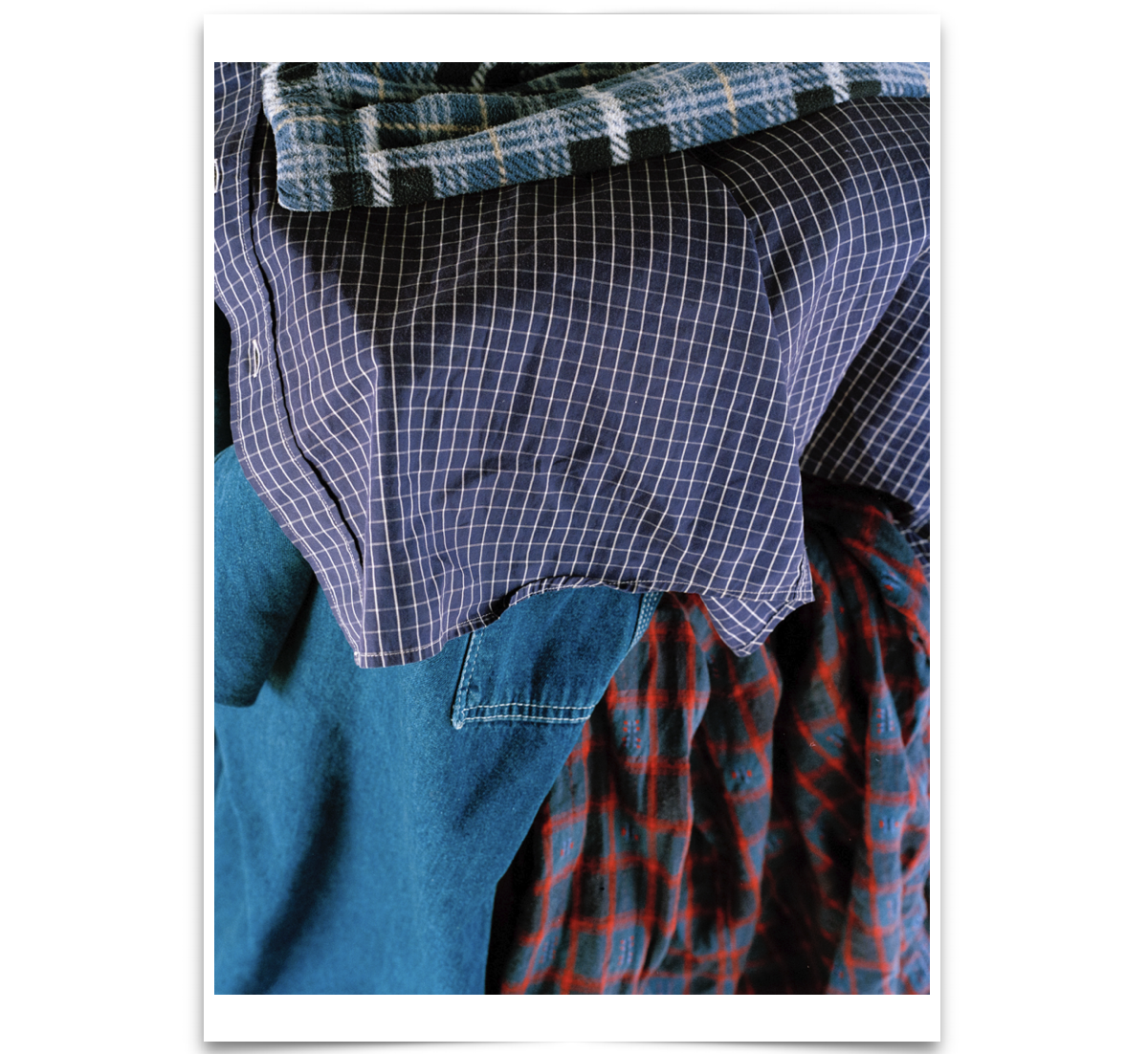
A good example of this can be found in an image that I featured in my exhibition “WHEN SEEING BECOMES FEELING”. This image presents a layered composition made up of different garments. The fabrics are stacked and folded over one another, filling the frame and removing any clear sense of surrounding space. Rather than offering depth or a stable viewpoint, the image directs attention toward surface, encouraging the eye to move across the materials. As my eyes grazes the surface of this image I notice the difference in material thickness, feel and quality. I can predict the softness of the garment at the very top and compare it to the thin stiffness of checkered shirt underneath it. The parts in focus feel like their almost protruding out of the frame toward the viewer, while the softer focus in other areas creates a subtle sense of depth. However, this depth does not lead into a fully defined space. Instead, it remains shallow and surface-oriented, keeping the viewer close to the image. My eyes do not move into the image but across it, following folds, seams, and patterns. This makes me read the image in a similar way to how I interacted with sensory books i flipped through as a child.
Roland Barthes speaks on how certain images can activate the viewer through “animation”, a moment in which the photograph appears to reach the viewer, and the viewer, in turn, animates the image. (Barthes, 1980 p.20) This is what I attempted to do through my own images in a solo exhibition I hosted in the beginning of November last year, where the aim was to create bodily engagement and projection.
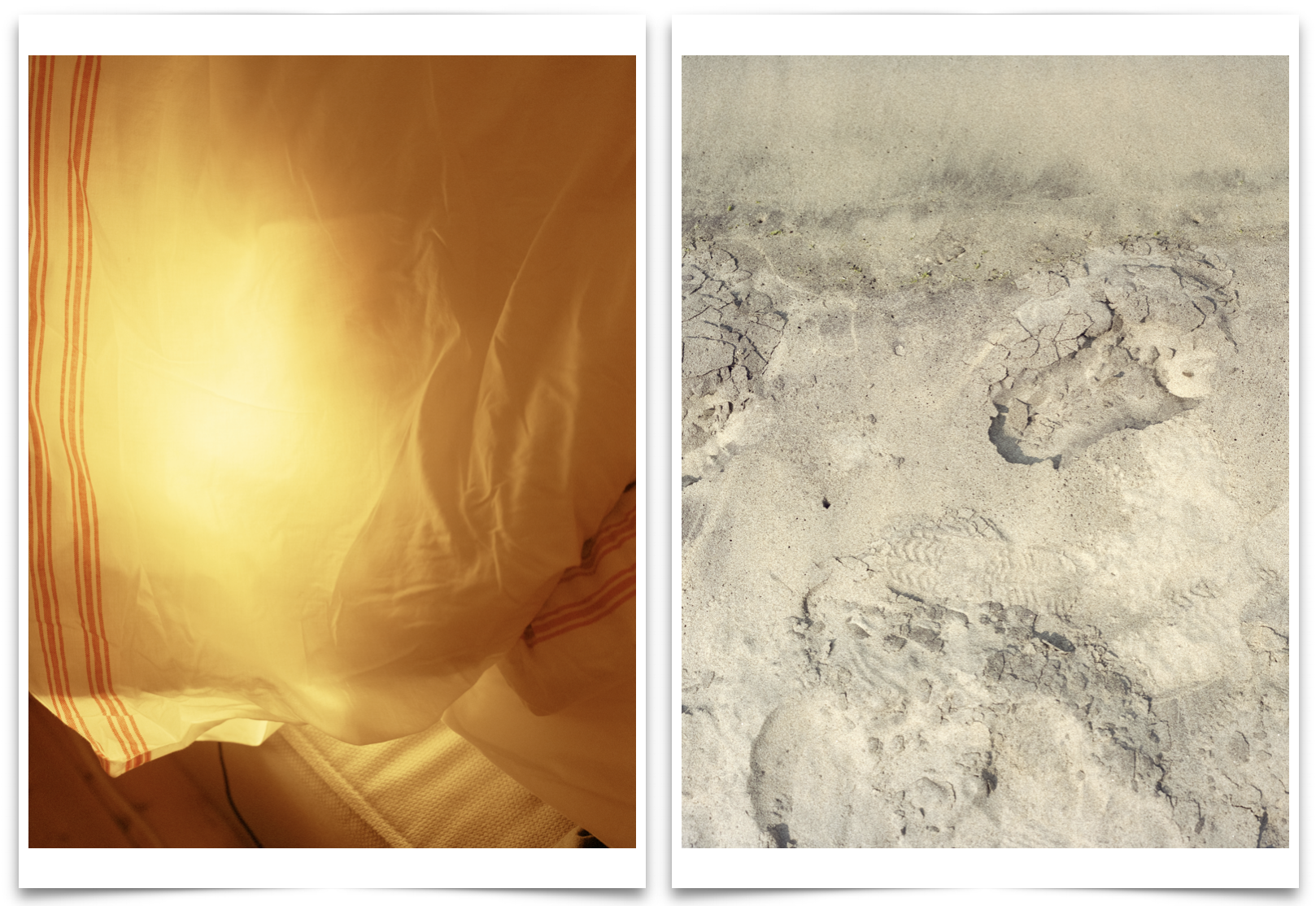
Here we can see two images that suggest tactility in two different ways, yet both rely on a viewer’s bodily response to become fully experienced. In the left image, a slightly translucent white fabric fills the frame. There’s a bright yellow light being diffused through the material, coloring everything in a warm yellow hue, drawing my attention to its surface and subtle variations in texture. My eyes move slowly across the surface, following the creases and the slight shifts in opacity. I begin to imagine the thinness of the fabric, how it might feel between my fingers, light, soft, and slightly warm from the light passing through it. In contrast the right image presents a sandy surface marked by footprints. Scanning the image I can almost feel the roughness under the soles of my feet, the slight resistance of the ground, and the way the sand might shift with pressure. The footprints imply past movement and future interaction, activating bodily memory of walking on this sandy terrain and compressing it under my own weight.
The bodily responses these images provoke such as warmth, softness, roughness, pressure, can be understood through Ellen Esrock’s idea of interoception, where visual stimuli trigger internal sensations within the viewer’s body – introducing it as “our sensing of the internal milieu… or what I also call the inner bodily state” (Esrock, 2010 p.217) and describes it as a key part of aesthetic experience. I also noticed how the footprint encourages me to engage with both images through my feet. I begin to imagine my weight being applied to both situations. Stepping into the frames, feeling my weight being absorbed in differing ways. The image to the left; suggesting a cushioned landing, in comparison to the dry and granular welcome that awaits to the right. I find this play between the two images creates a dialogue that adds another layer of engagement and animation, one that would not exist if the images were viewed separately.
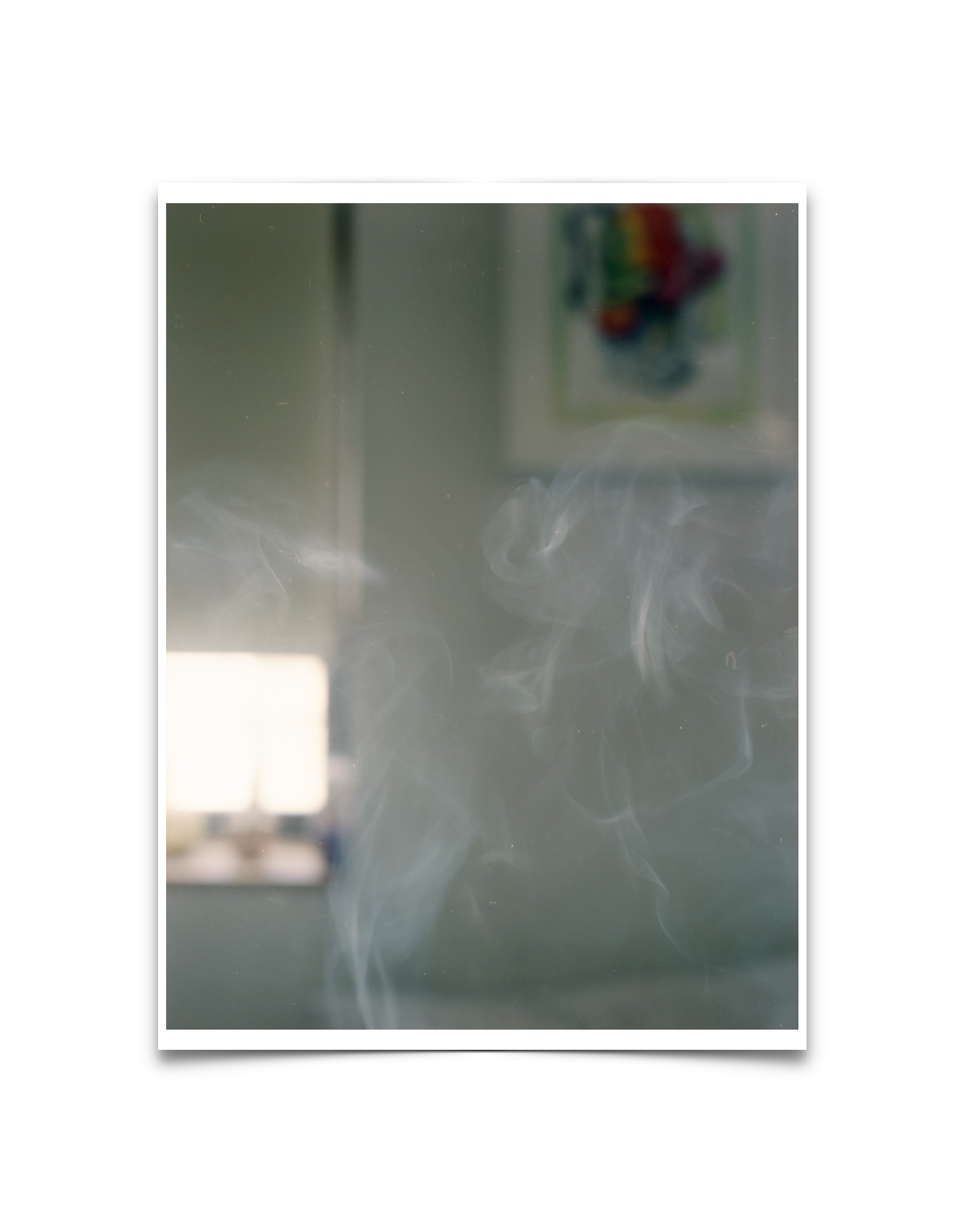
Ellen Esrock introduces empathy as a central themes in her article, describing it as a process in which “empathy… involves a projection of some aspect of one’s body or self into objects and others in the world” (Esrock, 2001 p.228). This kind of bodily projection can be felt when viewing this image. Unlike the previous images, which rely on solid materials such as plastic, fabric, or sand to activate the viewer, this image offers something far less tangible. The subject (smoke) lacks structure, weight, and fixed texture. At first glance, it may seem as though the image lacks tactility altogether. It cannot be held or grasped, yet it still produces a strong sensory response in which a sense of touch remains. Compared to the earlier images, where tactility is grounded in texture and physical contact, this image suggests a more diffuse and atmospheric form of tactility. It does not invite touch in a direct way but instead surrounds the viewer, creating a sense of immersion through air and movement rather than surface and materiality.
Drifting lines of smoke stream in from the bottom of the frame and gently disperse while gaining altitude, creating a sense of lightness and fluidity. The background’s out of focus which combined with the blur of the smoke, removes any clear sense of space. However, in this case, engaging with it through surface becomes less obvious. I think of the smell of smoke, its fragrance and the slight warmth it might carry. The sensation of my hand passing through it, accompanied by a dryness in the throat or a sting in the eyes from the close proximity to the smoke. These sensations are not visible in the image, yet emerge through a relational encounter between image and viewer. This bodily projection happens almost without conscious control. The encounter feels almost intimate.
This image demonstrates that visual tactility does not depend on solid materiality. Even something as intangible as smoke can activate a bodily response, suggesting that tactility can operate through atmosphere, movement, and memory just as much as through texture and surface.
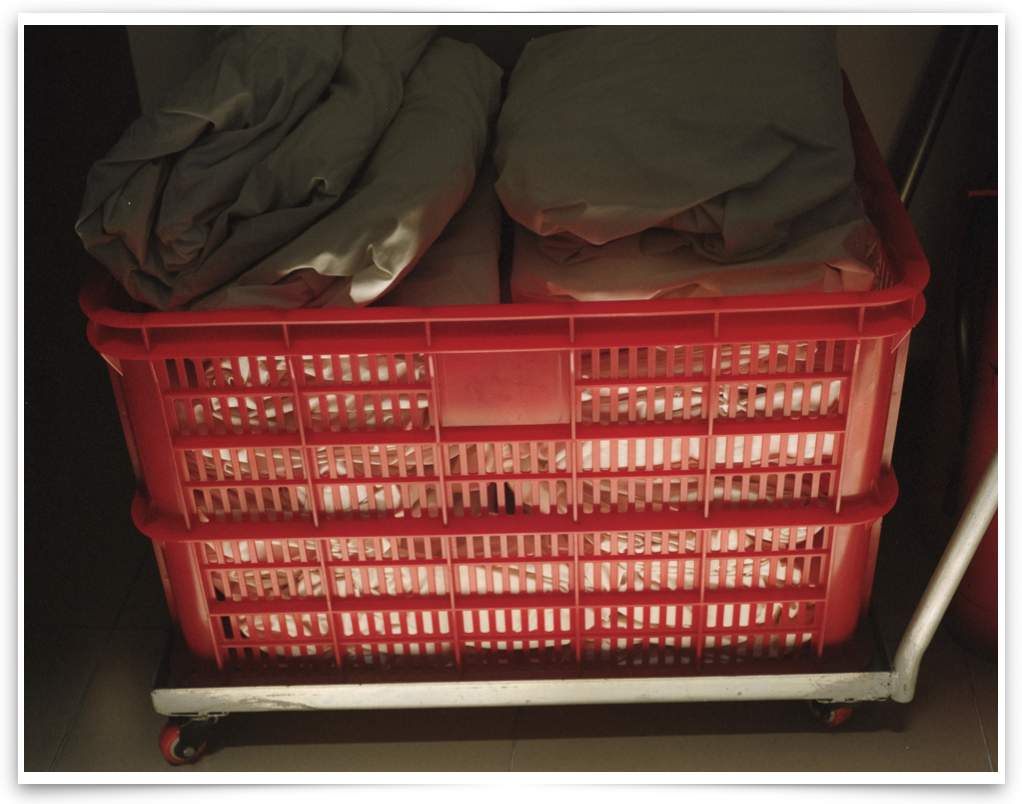
What becomes clear through these images is that tactility does not depend on what is depicted, but on how the image invites the viewer to engage. Whether through a softly lit red basket holding sheets, garments stacked and folded over over one another, light shining through a thin fabric, footprints in the sand or smoke rising past the frame – these images shift perception away from detached observation toward a more bodily way of seeing, where looking becomes a form of feeling.
Pictures: Sebastian Vetsch
FIG 1. from solo-exhibition “WHEN SEEING BECOMES FEELING”, 2025
FIG 2. from solo-exhibition “WHEN SEEING BECOMES FEELING”, 2025
FIG 3. from solo-exhibition “WHEN SEEING BECOMES FEELING”, 2025
FIG 4. “en ny dag omme”, 2022
Bibliografy:
Scheltens & Abbenes, MacGuffin, SOAP, 2021
https://www.scheltens-abbenes.com/work/macguffin-the-rug
Wolfgang Tillmans, Still Life
https://publicdelivery.org/wolfgang-tillmans-still-life/
Rinko Kawauchi, Untitled
https://www.artsy.net/artwork/rinko-kawauchi-untitled-48
Vivianne Sassen, Parasomnia
https://www.vivianesassen.com/works/parasomnia/carousel/#enice
Barthes, R. (1980). Camera Lucida : Reflections on Photography. Translated by R. Howard. New York: Hill And Wang.
Marks, L.U. (2000). The Skin of the Film Intercultural cinema, embodiment, and the Senses. Durham: Duke University Press, pp.126-195.
Esrock, E.J. (2010a). Embodying Art: The Spectator and the Inner Body. Poetics Today, 31(2), pp.217–250. doi:https://doi.org/10.1215/03335372-2009-019