The Bridge Between Music and Photography: Images as Spaces to Feel, Linger, and Connect
In music, the bridge section often works by putting the listener slightly off balance. While the chorus is familiar and predictable, the bridge introduces a moment of uncertainty. It breaks the flow, creates tension and anticipation, making the return to the chorus feel more intense.
Songs are often structured through recurring sections such as verses, a pre-chorus, a chorus and sometimes a bridge. The pre-chorus builds tension and prepares the listener for the chorus – the moment of collective recognition – whereas the bridge differs from both. It usually appears once and introduces a distinct melodic, harmonic, or lyrical shift.
Rather than reinforcing familiarity, the bridge interrupts it. By breaking the established pattern, it creates contrast within repetition. Not all songs contain a formal bridge section; however, when it appears, it marks a structural deviation that temporarily unsettles the listener before the song returns to its main structure.
Although the bridge can be defined as a structural shift within a song, what interests me is not its technical position. It is the emotional space it opens – a brief interruption where familiarity is suspended and the listener remains in uncertainty before recognition returns.
In an interview, British musician Dominic Harrison, known as Yungblud, expresses a similar idea about artistic practice, stating: “When you write something and you are terrified to put it out, that is when you’re onto something cool. Risk and complete truth is the only thing […] if you feel something so deeply […] the chances are that probably a lot of people will feel the same way.”1
This highlights how a deeply personal feeling can resonate with others, creating connection even before it is fully articulated.
When working with autobiographical approaches, it is easy to relate to this statement. Starting from this reflection, this text explores how the concept of the bridge can be applied to photography. Using music as a familiar reference point, I will examine how moments of tension, interruption, or vulnerability within an image or a series can open a space where personal experience may gradually become recognizable to others.
As in music, visual artworks can also contain moments that function like a bridge – interruptions that create tension or uncertainty and delay immediate recognition.
In photography, there can be moments that function in the same way as the bridge in music. These are not necessarily dramatic or spectacular images, but situations of exposure – where something raw, vulnerable, or unresolved is presented without immediate explanation. Rather than offering instant recognition, a single image may function as a bridge by destabilizing the viewer. It asks them to pause, to remain with the image, and to feel before interpreting, creating a moment of suspension where attention and awareness deepen.
Although this pause may occur within a single image, it can also unfold within a series of images. In this context, one photograph may interrupt the sequence, creating contrast or tension that alters the rhythm of the viewing experience. This “structural bridge” guides the viewer through the series, opening a space to process what precedes and anticipates what follows, allowing recognition and connection to emerge progressively.
Photographic work seems to oscillate between moments of immediate recognition and moments of opacity. In some works, recognition is delayed so that the viewer may feel something first, remaining within the image before attempting to interpret it. In this sense, the photographic bridge becomes a temporal space – not a passage to immediate understanding, but a suspension where attention deepens – a bridge toward connection, not the coalescence of recognition itself.
This raises a central question within photographic practice: how does one move from the specific to the broad, from the individual to something others can recognize?
Working with an autobiographical approach has often made artists question whether their work might be too personal for others to connect with. When dealing with family archives and intimate material, there is also a hesitation about showing the work publicly – not only out of concern that it may remain inaccessible, but because one may not yet feel ready to expose it. The difficulty is not always about the audience’s ability to understand, but about the artist’s readiness to release the image.
This tension is reflected in the writing of Jo Spence, a British photographer, writer and photo therapist, who questioned whether work should remain ‘private’ or become ‘public’, part of a broader social or political act. She reflects “I needed to be sure that I had already become separated from the specific memories/fantasies which lay behind it. Only at that stage could I feel safe enough to share the work.”2
In response to such concerns, making certain works more cryptic can appear to be a way of creating broader resonance. Yet these attempts do not always develop as strongly as more explicit works. Paradoxically, when images remain direct and emotionally exposed, they seem to generate a deeper connection.
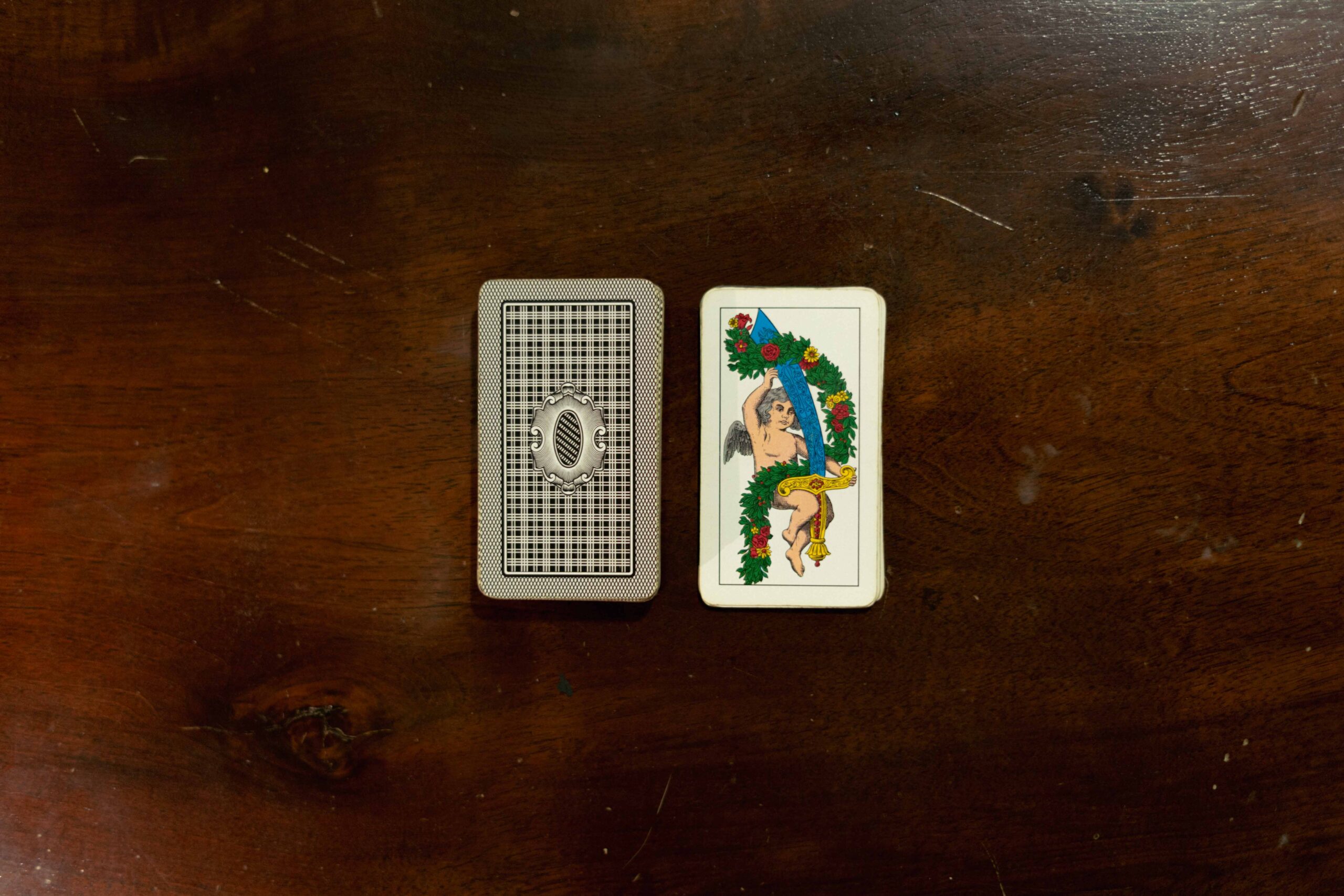
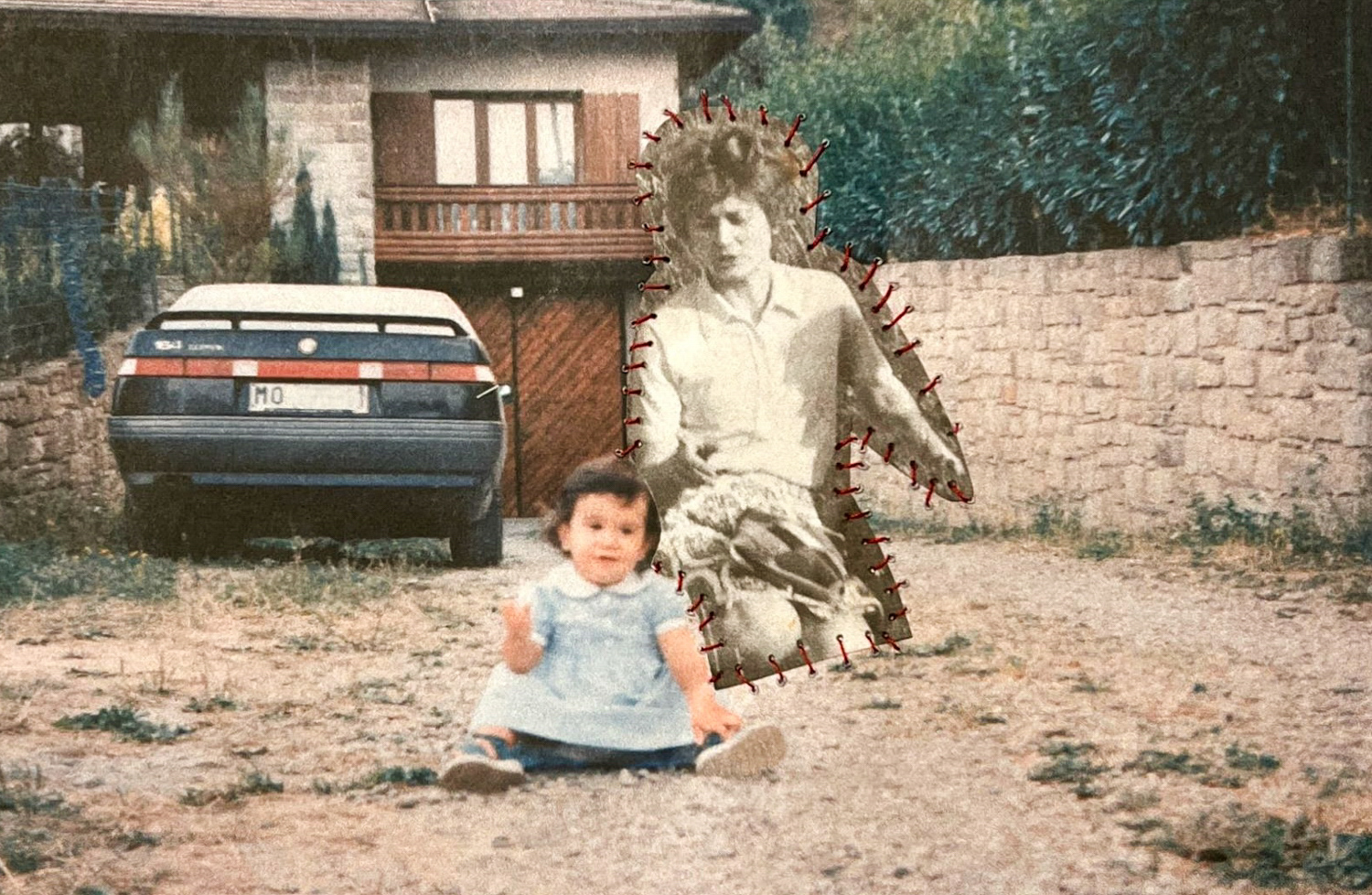
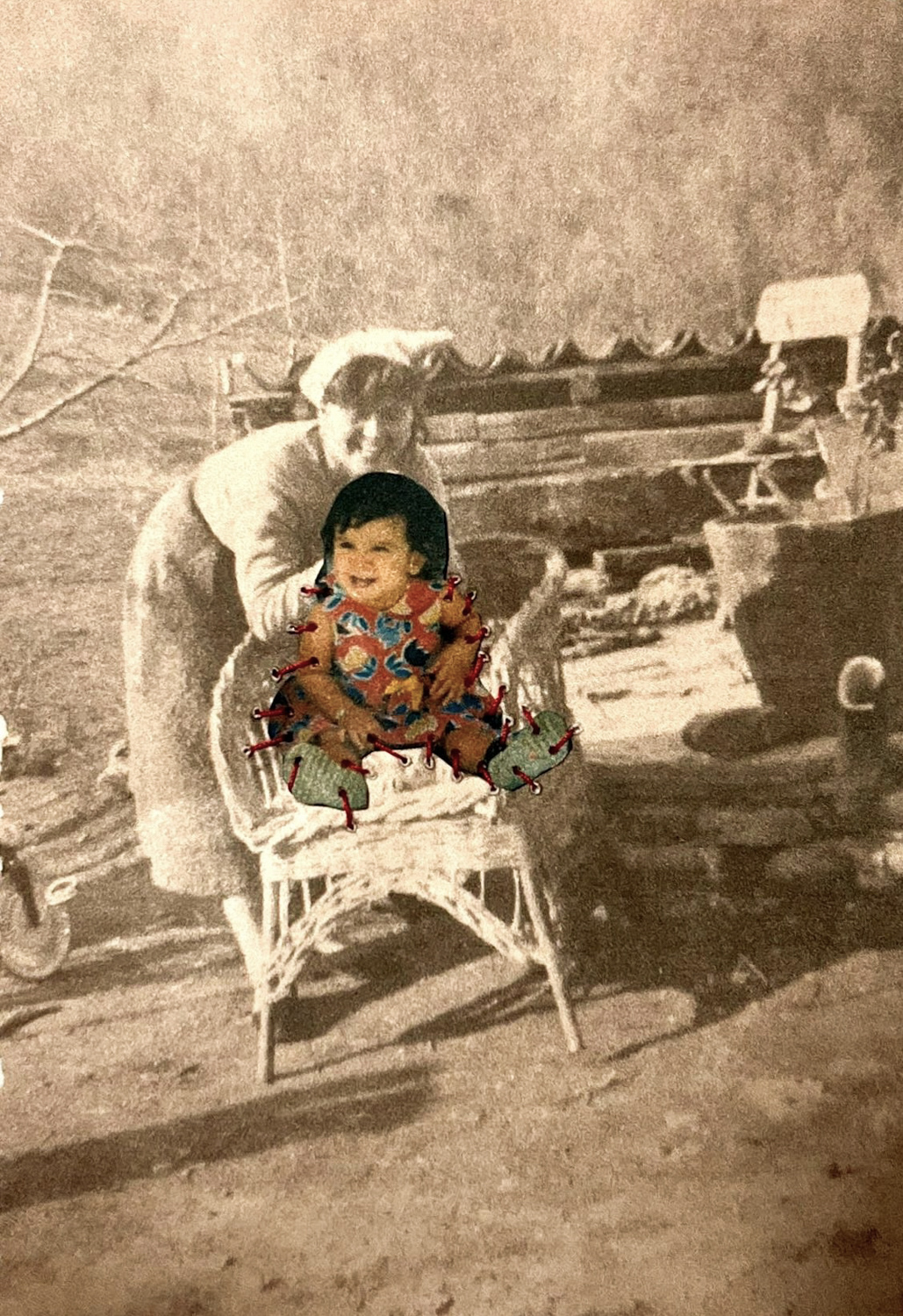
A similar tension emerges in my project pòvra la me putèina (my poor little girl). The work originates from an absence: the lack of photographs of me together with my grandmother, who passed away. From this absence, I began to reflect on the distance and fragility of affection within my family. The only expressions of affection were verbal, but not in the conventional sense – as the youngest grandchild, for anything I was “pòvra la me putèina”, in Modenese3 dialect, meaning “my poor little girl”. A way of protecting me, but one that, as I grew up, I felt ashamed of, because it made me feel small and fragile.
The project attempts to reconstruct an image that never existed. Through the re-elaboration of the family archive, I insert myself into spaces connected to her memory, eventually arriving at a photograph in which I stand beside her grave, leaning on it, seeking comfort.
While the work is deeply autobiographical, the absence it addresses is not singular. The experience of unresolved affection or of trying to rebuild a relationship after loss, can resonate beyond the specific personal and family context. In this sense, the movement from the individual to the recognizable does not happen through simplification, but through the exposure of emotional structures that others may inhabit differently.
The project matters here as an example of how autobiographical photography may move outward through emotional structure rather than through generalization. As photographer Martin Parr notes, “Unless it hurts, unless there’s some vulnerability there, I don’t think you’re going to get good photographs.”4
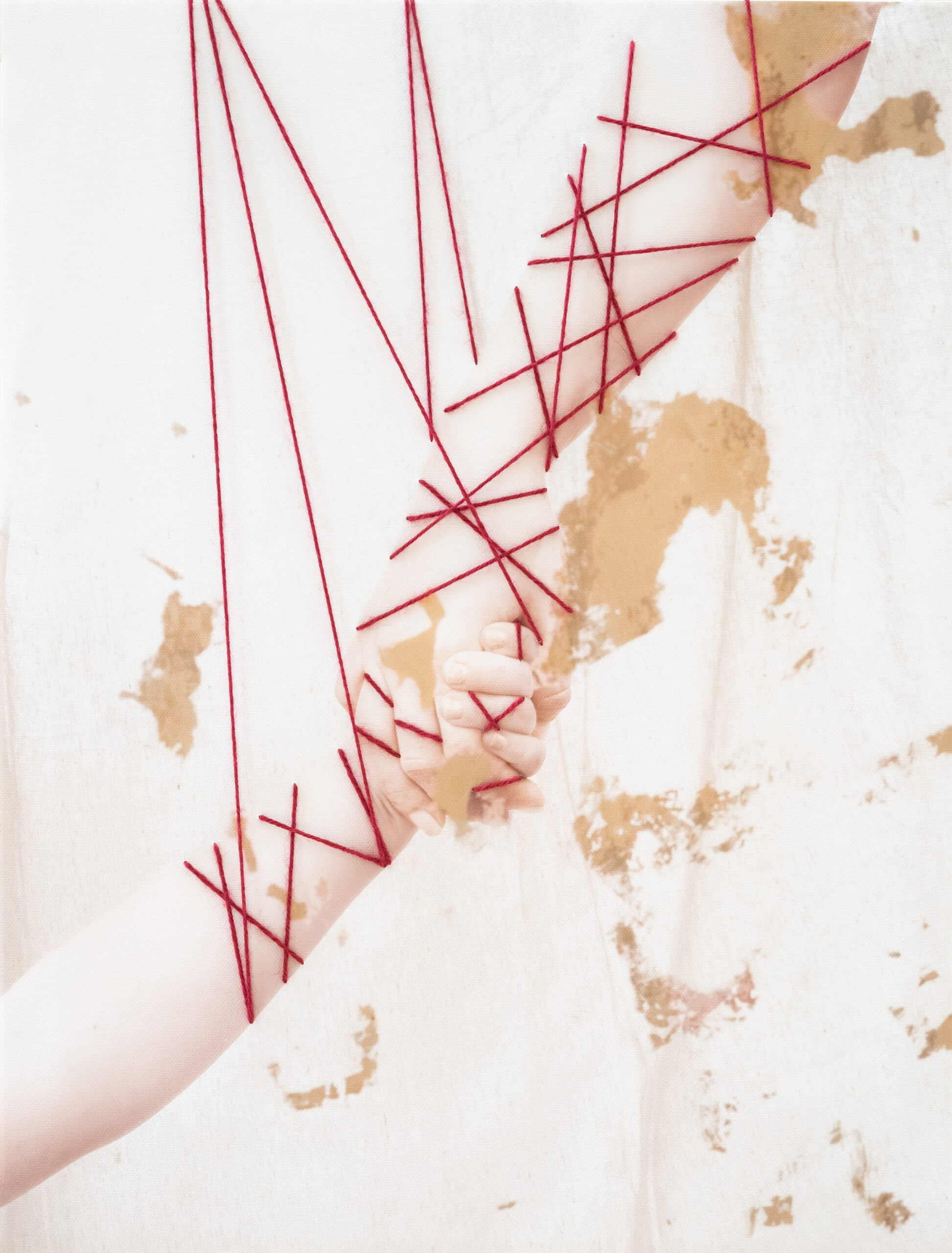
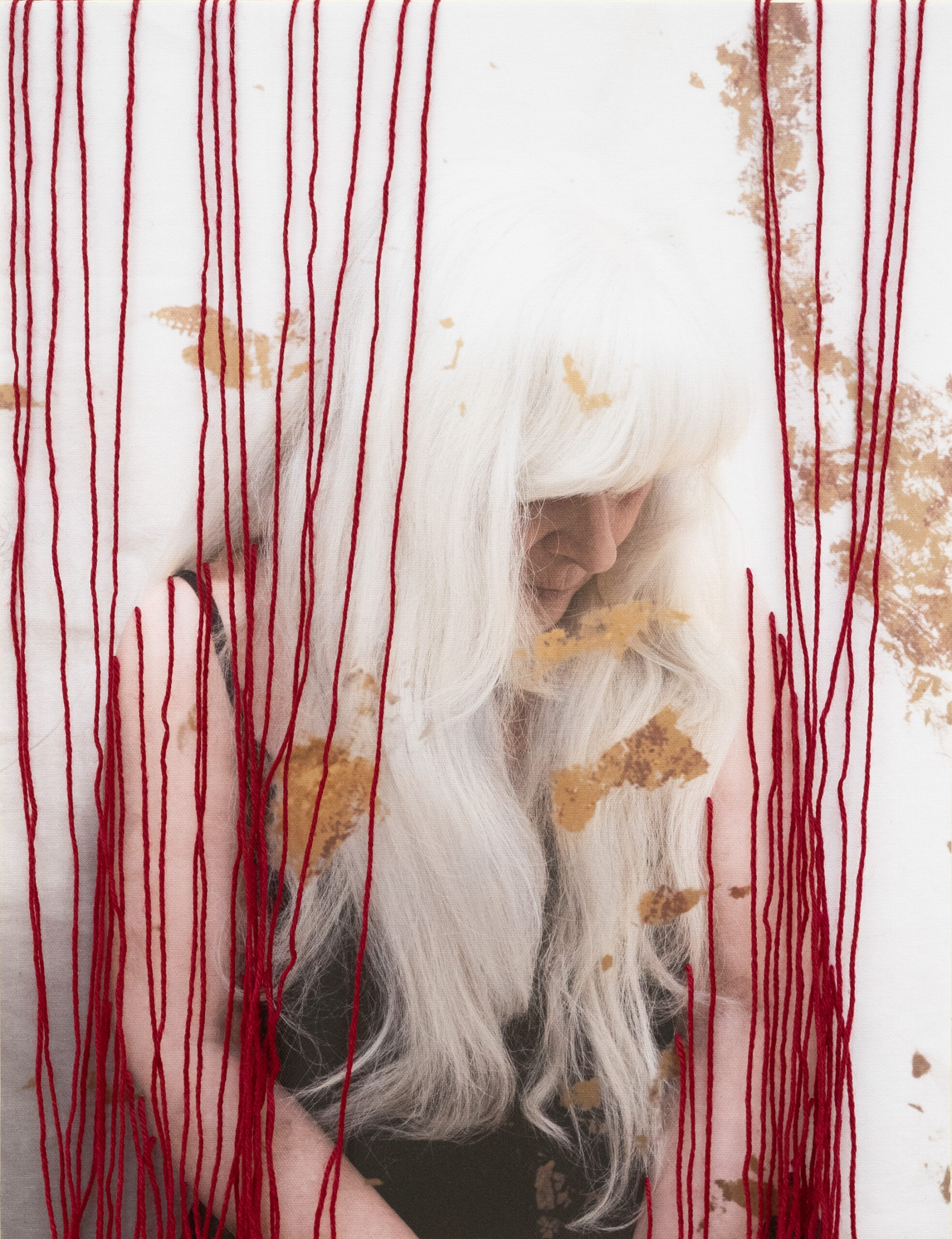
While the project pòvra la me putèina operates in a space that is intimate yet relatively legible – inviting immediate recognition through shared human emotions – other works take a different approach. For example, in my series Can you afford to be an individual? the images present more ambiguity and tension – figures entangled in red threads, reflections and distortions, create a pause in understanding. These works function more like a photographic bridge in the musical sense, delaying recognition and asking the viewer to remain with uncertainty before interpretation occurs.
Together, these two modes illustrate the oscillation between immediate connection and a slower, more suspended engagement, highlighting how the photographic bridge can operate both within a single image and across a series.
Taken together, these reflections suggest that the bridge is more than a metaphor borrowed from music. In photography, it can describe how images create relation on multiple levels – between the viewer and a single photograph, where attention and emotional engagement unfold gradually, and between images within a series, where one photograph may interrupt or redirect the rhythm, guiding the viewer through a sequence of experiences.
Seen in this way, the photographic bridge is not a direct passage from the personal to the universal. It is a fragile space in between – where familiarity and distance coexist, and where meaning does not settle immediately.
It is not a single moment that connects one experience to everyone else. Rather, it is one of many possible crossings – a temporary alignment between one individual and another, one image and one viewer. Through these small and partial connections, a personal moment may extend outward – not by becoming universal, but by resonating differently each time it is encountered.
The bridge, then, does not bring artist and viewer, or artwork and connection, together immediately but opens a space that allows attention, vulnerability, and recognition to unfold slowly – a space where connection is not given but gradually built, as the viewer engages with the work over time.
Notes
1 Dominic Harrison (Yungblud), ‘GRAMMY U Masterclass with YUNGBLUD’ [YouTube video], uploaded by Recording Academy / GRAMMYs and Allison Hagendorf, 30 January 2026, https://www.youtube.com/watch?v=IVZFBwaFP8 [accessed 31 January 2026].
2 Jo Spence, Cultural Sniping: The Art of Transgression, ed. Jo Stanley (London: Routledge, 1995) p.198
3 Modenese is a variety of the Emilian dialect spoken in Modena, northern Italy. It preserves local expressions and nuances that often do not have a direct equivalent in standard Italian.
4 Martin Parr, ‘Unless it hurts…’, quoted in Martin Parr Quotes: Creating Fiction out of Reality, Photogpedia, https://photogpedia.com/martin-parr-quotes/ [accessed 9 March 2026].
Images
Fig 1. pòvra la me putèina (my poor little girl), Sara Tonioni (2026)
Fig 2. pòvra la me putèina (my poor little girl), Sara Tonioni (2026)
Fig 3. pòvra la me putèina (my poor little girl), Sara Tonioni (2026)
Fig 4. Can you afford to be an individual?, Sara Tonioni (2024)
Fig 5. Can you afford to be an individual?, Sara Tonioni (2024)