
The Grid as a Framework: Structure as a Creative Tool
Back in elementary school, I enjoyed making math assignments. I especially enjoyed drawing the results on gridded notepaper. After I finished solving a given math problem, I would stay up late into the night to make sure the results were stated with precision. Each heading marked with a contour of the squares, and all equal signs placed in a vertical line.
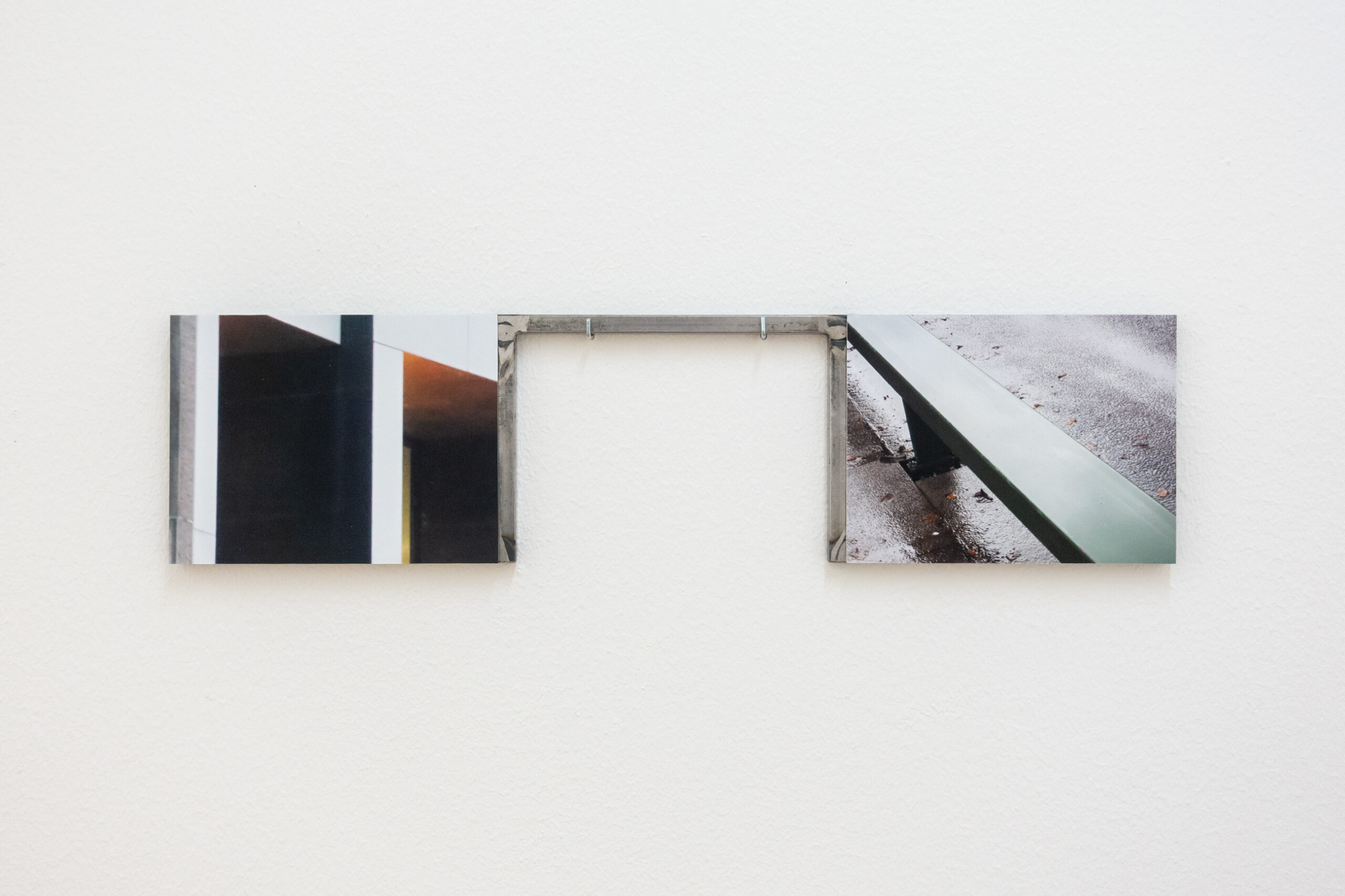
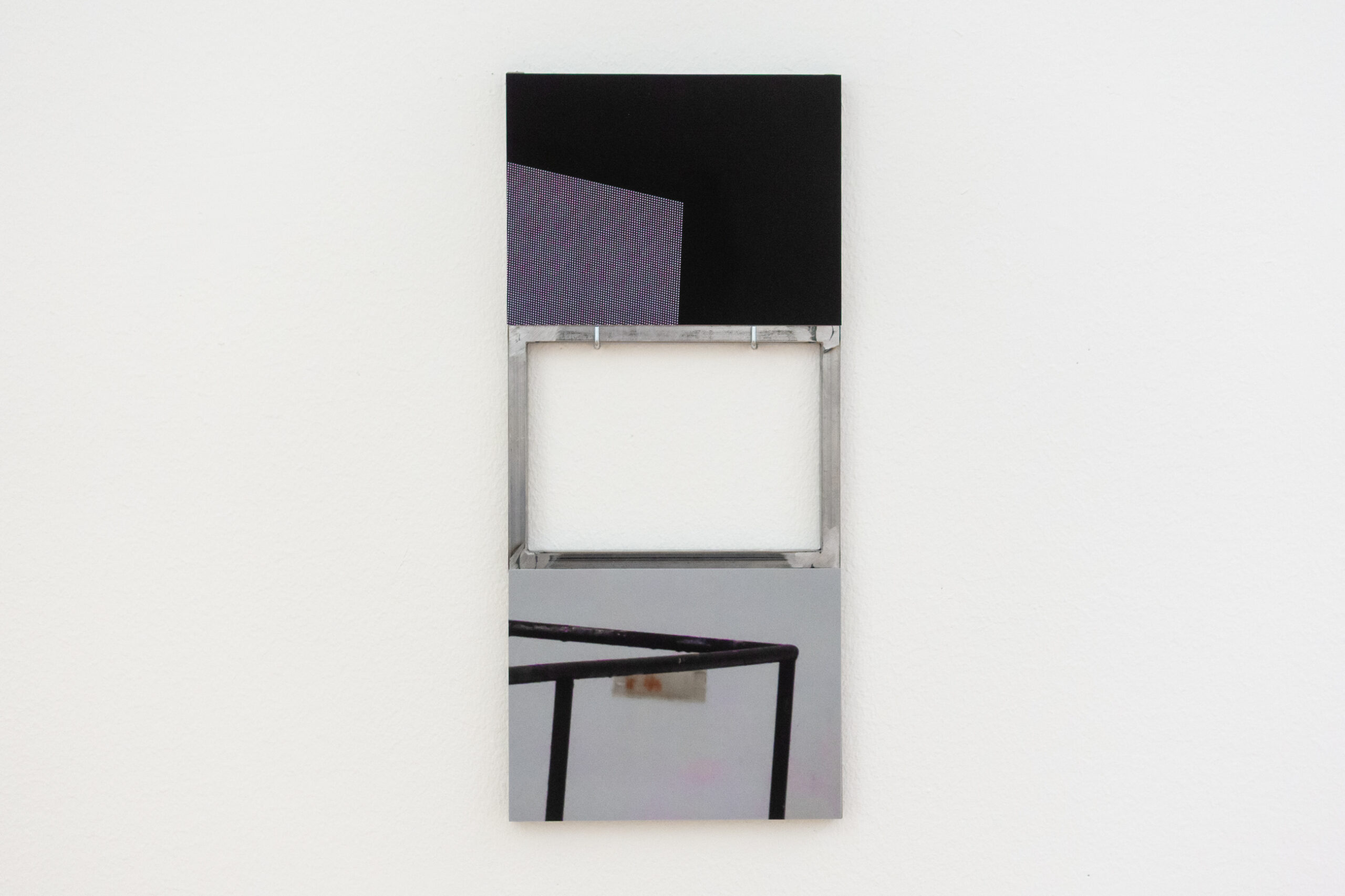
Recently, this interest has returned, now materialised as grids of metal that serve as frameworks for my photographs. The grid informs the creation at several stages: in pixels, sculpting and organising. What characterises the grid and makes it so appealing in the process of creation?
As a prevalent pattern, the grid has played a significant role throughout art history, particularly in minimalism. An expert on its aesthetics is painter Agnes Martin. In an essay on her work, curator Lynne Cooke outlines some key characteristics of the grid, drawing on art critic Rosalind Krauss:
the orthogonal grid is not only non-hierarchical, infinitely extendable, and nonrelational but also projected as if seen from no vantage at all. [1]
Krauss argues that the grid serves as an emblem, but also as a modernist myth:
The grid’s mythic power is that it makes us able to think we are dealing with materialism (or sometimes science, or logic) while at the same time it provides us with a release into belief (or illusion, or fiction). [2]
With its objective pursuit and infinite expendability, the grid combines the idea of logic with that of illusion, both of which are present in Martin’s paintings. Even though Martin delt with a narrow field of motifs, primarily grids and lines, she developed a diverse range of visual expressions. Distinctive are her meticulous lines on the canvases, pointing to patience and consistency; something I could recognise from my own experience of working with the gridded notepaper, and, more recently, with the structures for my photographs.
Martins’ approach, as well as my own, points to attention; a concept which philosopher Simone Weil’s has reflected upon. Weil argues that the modern world is marked by rootlessness and materialism [3], and presents attention as a practice through which one can connect to a reality beyond the self. For Weil, attention is a matter of devotion, not an intellectual process. It is about reflecting on an issue rather than solving it, to stand still rather than lean in [4].
the way in which the parts of something are connected together, arranged or organized; a particular arrangement of parts. [5]
Arrangement is core, as in terms of distance, colour, shape, chronology, or affective value. The options depend on the content to be arranged in a specific context, whilst the choices made depend on the focus of attention.
Conversely, what does it mean when something is unstructured? In opposition to structure, we have terms as ‘chaotic’, ‘messy’, ‘disorganised’, and ‘formless’. Despite their negative connotations, these concepts suggest a contrasting value: the structure must be flexible enough to accommodate autonomy. This as well is the price to pay, if the structure becomes too rigid.
The use of structure can be more or less apparent throughout a creative process. Sometimes it is subtle, unconscious or even invisible. My former teacher, the artist Annika von Hausswolff, stated in a lecture on photographic practice that art is a matter of decision-making. From the first attempts to the final presentation.
Observing one’s own practice is a way to identify the structures of those decisions. Sociologist Howard S. Becker reflects across sociology and photography, arguing that a particular idea is typically identifiable in the early stages of a work:
Like the sociological fieldworker, who finds much of his later understanding latent in his early data (Geer 1964), he [the photographer] will probably find that his early contact sheets, as he looks back through them, contain the basic ideas that now need to be stated more precisely. [6]
As we become aware of our own practice, we can focus our attention forward.
Being conscious of the circumstances and interventions we bring to this process enables us to experiment systematically in accordance with our focus of attention. A core factor is time, for instance, crucial for patience and immersion. Another is consistency, in our attention and the decisions we make.
When does a structure become too intrusive and stifle the creative process? A choice of consistency, such as the weather conditions, can determine the gaze to such an extent that it blocks our attention, the possibility to look openly at our surroundings. Similarly, if the lines on the notepaper are too dominating, the mark of the hand is silenced. The lines thus dictate the possibilities to unfold, functioning as restrictive rather than inviting. A structure must be flexible and the creator free to explore. It serves as a guide, modifiable in response to the material.
With the right emphasis, structures enable alternation between overview and immersion, form and autonomy, serving focused attention throughout a creative process. The grid on a sheet of paper helps divide it into parts, allowing us to zoom in and approach it with consistency. We might start by marking some squares over others or defining a specific distance between our markings. Each step is a decision, conscious or not, that with focused attention brings us closer to the material, connecting us to the world around.
Images:
Fig 1. Barbara Marstrand, Graph paper, 2026. Scanned sheet of paper. 29.7 x 21 cm.
Fig 2. Barbara Marstrand, Beams, 2025. Inkjet print, aluminium, steel. 13 x 52.9 cm.
Fig 3. Barbara Marstrand, Corners, 2025. Inkjet print, aluminium, steel. 39 x 17.3 cm.
Notes:
[1] Lynne Cooke, ‘…In the classic tradition…’, in Agnes Martin (New Haven & London: Yale University Press, 2011), pp. 12-13.
[2] Rosalind Krauss, ’Grid’, in The Originality of the Avant-Garde and Other Modernist Myths (London: The MIT Press, 1986), p. 12.
[3] Simone Weil, Rodfæstelsen (Copenhagen: Forlaget Mindspace, 2023), pp. 51-59.
[4] Simone Weil, Gravity and Grace (London & New York: Routledge, 2003), pp. 13-15.
[5] ’structure’, in Oxford Learner’s Dictionary, https://www.oxfordlearnersdictionaries.com/definition/english/structure_1, accessed 5 February 2026.
[6] Howard S. Becker, ‘Photography and Sociology’, in Studies in Visual Communication, vol. 1, no. 1 (Philadelphia: University of Pennsylvania, 1974), p. 14.
[7] Bernd Becher, ’Estate Bernd and Hilla Becher’, on Sprüth Magers, https://spruethmagers.com/artists/bernd-hilla-becher/, accessed 14 February 2026.