“Tusentals små rätter” Image Composting in the Visual Ecology of the Swedish-Chinese Restaurant
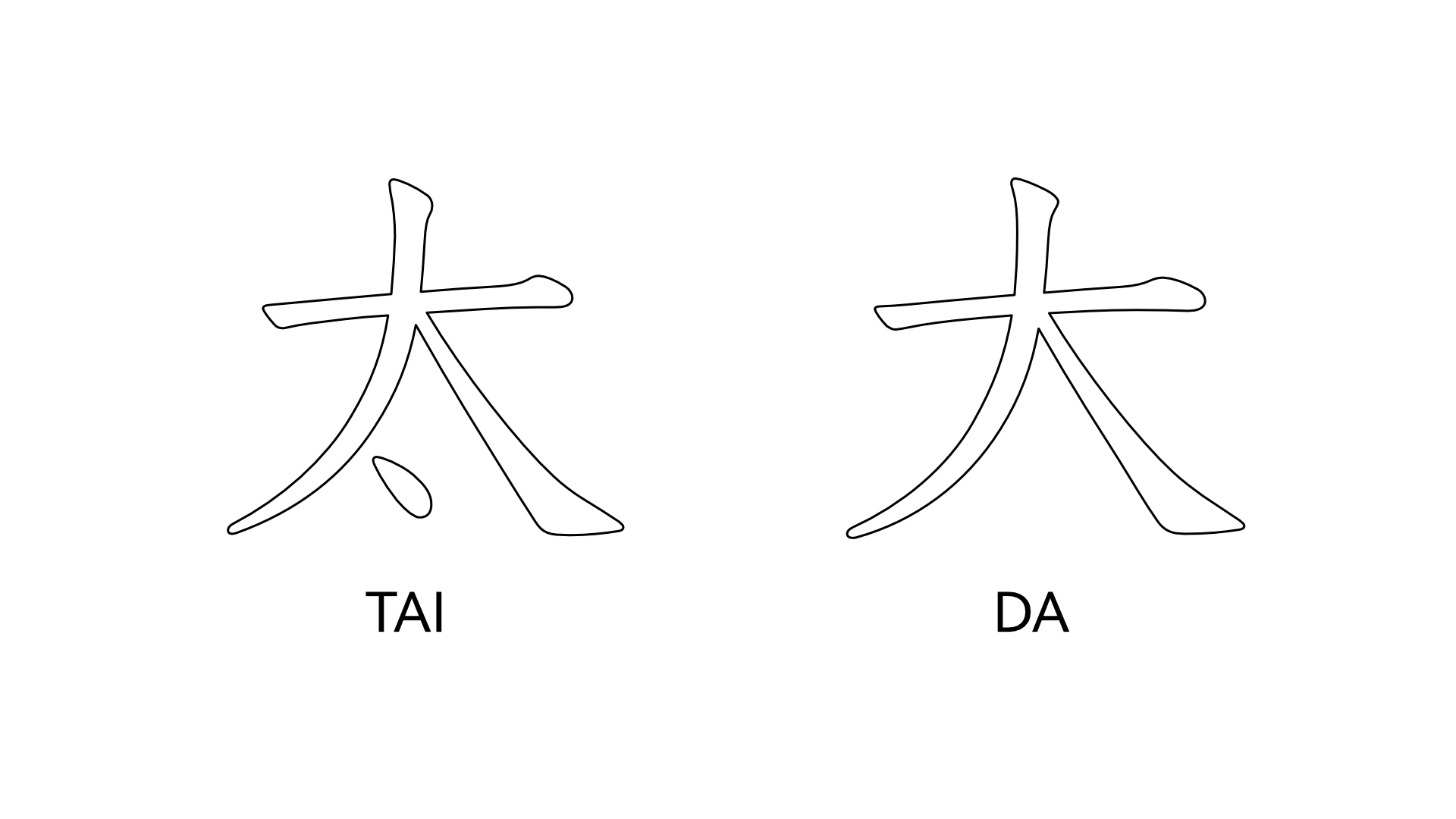
In Gothenburg, there is a Chinese restaurant called Tai Shanghai. At first glance, I assumed the Chinese would be 太—“supreme.” But the Chinese character on the sign is actually 大, meaning “great” or “big” and pronounced da in Mandarin, du in Shanghainese, daai in Cantonese – never tai.
I am told that the restaurant originally had Cantonese owners and later passed into Cantonese-Vietnamese hands; but neither would say tai. Is this a decades-old transliteration error, now fossilized? Is it a commercial calculation: perhaps tai sounds more Chinese to Swedish ears? Has there been a passage through some third language I cannot identify? The sign offers nothing. It simply persists, pointing toward a Shanghai to be found in no dictionary.
What of Shanghai itself? It is a city that neither Cantonese nor Vietnamese owners could call home. The name is but borrowed glamour. The “Tai” belongs to no mouth, the “Shanghai” belongs to no memory. The sign hints not at origin but a sedimentation of displacements, errors compounded into permanence.
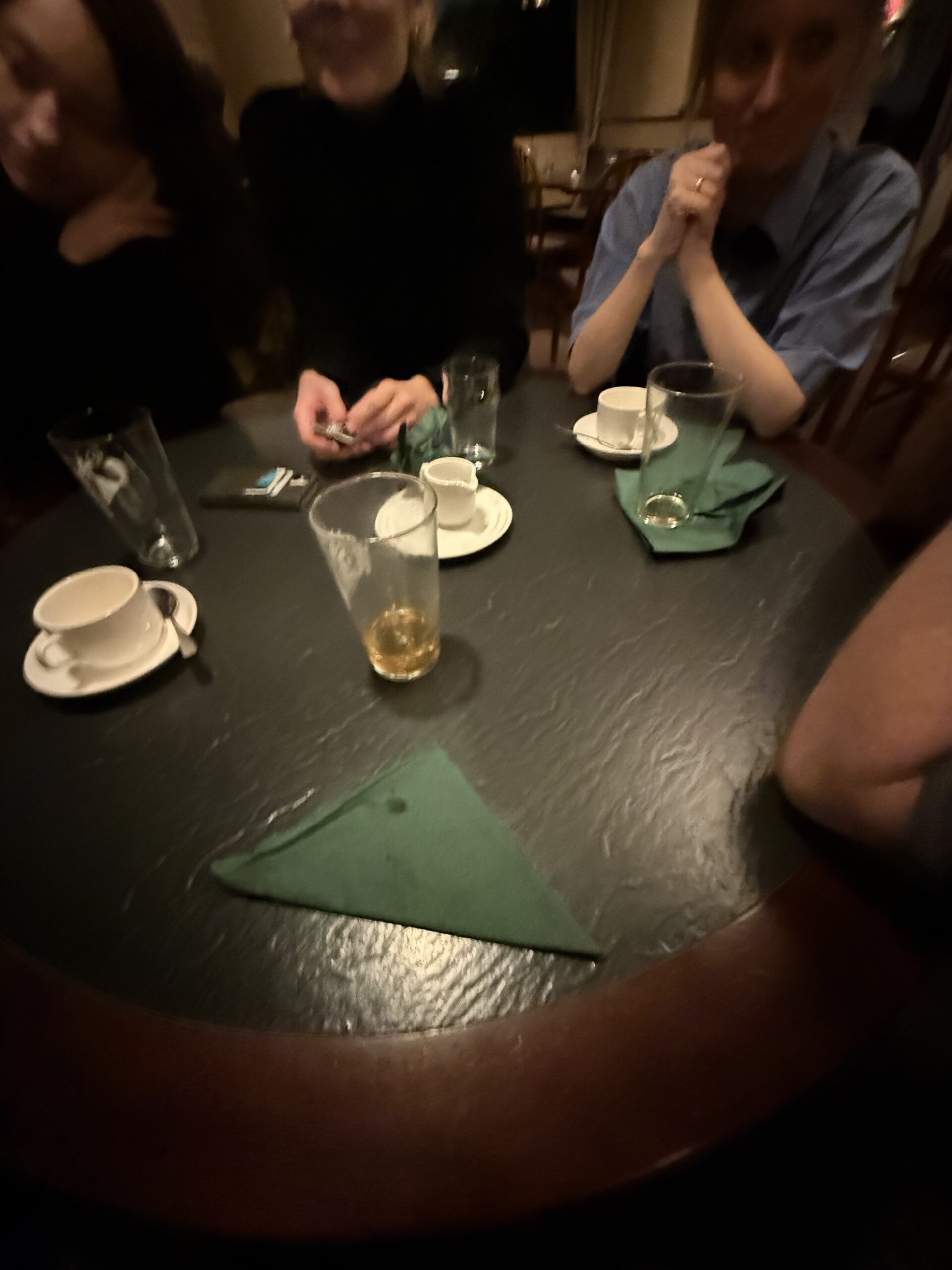
The interior décor speaks a similar tongue: dark wood, brass fixtures, landscape paintings and screens spanning entire walls. It presents a polished opacity that reminds me of the restaurant scene in Rush Hour: a perfect setting for Jackie Chan or Jet Li that could be in Copenhagen, Paris, or Los Angeles, but never Beijing or Guangzhou. The menu offers kinamat – sweet-and-sour pork, fried rice, spring rolls – no Shanghainese dishes in this “Great Shanghai”, yet authentic to forty years of Swedish appetites.
I try to understand what I am looking at. I begin to consider calling this process an image composting: something has died and something has grown there in this whole scene as an image.
Tai Shanghai is no exception. In the 1970s and ’80s, if you wanted foreign takeout in Sweden, you had two options: pizza or Chinese. Pizza, Italian in origin, has been thoroughly domesticated since 1947 in a manner that is European, understandable, effectively local. Chinese food carries a different weight: for nearly two decades, it bore the entire semiotic burden of culinary otherness, with a loong (dragon image from the sinosphere) on the sign, red lantern in the window, and laminated photographs. These provided the visual vocabulary through which a generation first encountered “the exotic”.
Sweden’s first Chinese restaurant opened in Gothenburg in 1959. By the ’70s, kinamat had become a national institution, standardized into a form so ubiquitous it needed a name: tre (och fyra) små rätter – three (or four) small dishes – offering a set menu, a contract. You knew what you were getting before you entered, mirrored in the loong, the lantern, and the chopsticks on the placemat. Thousands of restaurants, thousands of menus, and thousands of small dishes – tusentals små rätter – accumulated into something that could not so much be seen as inhabited.
A common argument in visual culture studies holds that images can die quickly. Digital circulation especially degrades them: pictures are copied, compressed, and progressively stripped of resolution until only ghosts remain. An excess of images makes them unconsumable, leading to self-cancellation: societies that produce the most images become the most iconoclastic, shredding meaning through sheer quantity.
Of course, not all images die this way. Some die slowly, sedimented into environments rather than circulated into oblivion, gaining density instead of losing resolution. Layer upon layer of expectation, stereotype, and visual debt accumulates until images are inhaled and exhaled as readily as air.
That’s how I see image composting: the slow decomposition of images into the background of environments they helped create. And the decomposition, as always, brings transformation. It makes of the composted image night soil; as the American feminist, theorist and philosopher of science Donna Haraway writes: “we are compost, not posthuman”. The composted image is dense, overfull even, heavy with decades of accumulated visual consumption. It lives on, becoming wallpaper, furniture, a backdrop against which all subsequent visual experience occurs.
Photography theory has long attended to how images circulate and serve as evidence. It has been less often asked what happens when photographs stop doing so yet fail to disappear: i.e., when they sediment into the environment as décor, menu, or signage. The laminated image of food on a Chinese restaurant menu may be the most widely distributed photographic image in Western culinary culture, yet it is never discussed as photography. It has composted too thoroughly to be seen as the image it is. French philosopher and musicologist Peter Szendy argues that contemporary images are not objects we look at but environments we move through. The Chinese restaurant in Sweden has become such a space: Orientalism has ceased to be discourse and become architecture. The loong might still be new and fresh to you, but once inside, you no longer notice it consciously. You walk past it.
Edward Said, Palestinian and American academic and political activist, describes Orientalism as a discourse of reproduction: a system that perpetually re-manufactures images of the East without reference to any actual such place. In the Chinese restaurant, this reproduction becomes environmental. The visual grammar of Western othering accumulated over decades of colonialism, trade aesthetics, and cinematic fantasy is composted into décor. The Orient depicted on the walls of Tai Shanghai does not represent China. It represents a hundred years of Western observation, compressed into wallpaper.
What composted during the years before other foreign cuisine reached the Swedish palate (1959–1980s) was not just an aesthetic preference but a visual regime. The arrival of kebab in the ’80s, then sushi in the ’90s distributed the burden of “the exotic” across multiple cuisines; but the grammar had already been established. The Chinese restaurant pioneered “ethnic food” as a visual environment; subsequent arrivals performed their variations on a theme already set.
Compost is not inert. Decay nourishes. Artists like Lap-See Lam have made the Swedish Chinese restaurant visible as a reservoir of diasporic memory – tracing inherited labor, vanishing interiors, and community-in-transformation – while the first-generation migrant or foreign traveler may see something else. Arriving from the country these images claim to represent, I meet an Orient that does not match the one I carry inside me. The Tai/Da confusion, invisible to those for whom the name has always simply been a name, becomes unavoidable. The seams show. I lay no claim to a superior vision, only a different one, not yet having naturalized into what I find on the walls.
Yet I eat here. I order the bamboo beef and General Tso’s chicken: dishes I have never had in China. I honestly enjoy them.
Besides, Chinese people have their own “foreign” cuisine. In Shanghai, the classic 罗宋汤 – luósòng tāng or “Russian soup” – bears little resemblance to any borscht a Russian or Pole would recognize. We use tomato, not beetroot; the broth is sweet-and-sour, adapted to Jiangzhe palates. It is Western food as reimagined for Chinese appetites, just as General Tso’s chicken is Chinese food reimagined for Americans. The composting of Orientalism is reciprocal. The “Oriental” restaurant in Gothenburg and the “Western” restaurant in Shanghai are mirror images, each serving an elsewhere manufactured for local consumption.
The composting continues. Many Chinese migrants in Sweden today open Japanese restaurants rather than Chinese ones; perhaps sushi carries a different market value than sweet-and-sour pork. However, step inside though, and another layer becomes visible: décor sourced from Taobao and Temu, a “Japan” manufactured in Shenzhen for Chinese domestic consumption now providing faux authenticity for Swedish customers. To those unfamiliar with contemporary Chinese e-commerce aesthetics, the performance is flawless. To my own sedimented visual grammar, shaped by years of training on the streets in China, the supply chain is clear. Compost recognizes compost.
Migration not only carries along sedimented images but also deposits new ones, drawn from visual economies – affective habitus, inherited aesthetic discipline, logistical imaginaries – invisible to the local gaze. The ethnic restaurant is a palimpsest: Orientalism layered upon Orientalism, each generation adding sediment from new sources and new supply chains.
The composted image names something visual theory has often overlooked: a mode of image persistence that is neither archival preservation nor algorithmic reproduction. It is slow, environmentally grounded, and generative. Images become the visual infrastructure of everyday environments. It can be an Irish pub, an IKEA-style café, a socialist mural, eventually the ground on which we stand and the air we breathe.
The sign of Tai Shanghai hangs on in Gothenburg, offering a mispronounced word and an invisible city. Perhaps, from the very beginning, all of it was wrong. Yet it persists, indifferent to correction, heavy with time, waiting for the next group to dine.
Bibliography
Haraway, Donna J. Staying with the Trouble: Making Kin in the Chthulucene. Durham: Duke University Press, 2016.
Said, Edward W. Orientalism. New York: Pantheon Books, 1978.
Szendy, Peter. The Supermarket of the Visible: Toward a General Economy of Images. New York: Fordham University Press, 2019.
Figures
Ji, Songyin, 2026.