WHO NOW TRIUMPHS, IN THE EXCESS OF JOY
We live in a divisive place, under the rule of affiliations and the accrued value of perception. Identity is a core currency in the contemporary art sphere; we frame exhibitions with biography and form interpretations through origin.
Dean Kissick’s controversial essay “The Painted Protest” (2024) in which the American based critic contends the value designated to the visibility of marginalised identities and the relevance of moral and political positions as an eclipse to the aesthetic and emotive experience of art. Kissick’s toe-stepping dispatch will read as reactionary to some while others will see it as appropriate nuance in a debate of arts value. I approached the essay with slanderous intent but instead Kissick evoked conflicting thoughts in me. He argues that the contemporary art produced and promoted today, are dominated by clear political messages, especially revolving identity, representation and social justice. Kissick means that institutions, curators and the art market is emphasising political themes, rather than aesthetic or conceptual innovation. In the opposition, there’s those that believe that his rejection of certain artistic practices is a reaction to the visibility of marginalised voices – in accordance with the regression of our political spheres.
When does identity expand artistic creation – and what jeopardizes its value?
The internet is new for some, but it’s here and with it the relations formed by institutes and commercial players are open for dissection. It’s harder to hide the fact that most will only elevate themselves – or others in whom they see themselves. Transparency is accompanied by the rapid appreciation of benign visibility – a resource needed to be able to traverse the corridors of culture, under the impression of being a benevolent actor. So, in this candid era, supposedly free from the panache of subterfuge, let’s call a cat by its colour and seek the exclaim of accurate questions. The subjugation by political capital is nothing new, maybe the definition of capital has shifted and through that shift been made more visible. What remains emphasised by artists, curators and dealers alike is the importance of relationships. There’s a clear political aspect in the art game. It’s overwhelming as there’s an inherent struggle in the evaluation of art and comparatively the assessment of character background and social ability is simple.
Kissick is right to resist this reduction of art to political posture, identity cannot replace the labour of form. Art can be probed and analysed but whatever effort exercised it’s impossible to find a translative counterpart to the experience of it.
The preconception of marginalised identity remains superficial, and the enforcers of cultural hierarchy seem to be scrambling in a crevasse of disconnect. Seemingly oblivious to the myriads of forms that expression and identity can take, they search for signifiers of marginality to be added and subtracted to form declarative sums, reaching for convenient legibility of identity instead of complex work. Academia seems to play a part in it, with the forging of intriguing contextuality implemented as an educational pursuit, rather than the quest of creation we seek a narrative profile to be sold and submitted.
The sovereignty of the created, rather than the creator, is indisputable to me. Perhaps I’m superficial, or indulgent – exalted in the flavour of things. Yet Kissick’s notion of an inability to affect the worlds rule creates a false opposition of politics vs aesthetics. We’re not here to decorate lobbies and halls – arts fervour should be an onslaught striking at souls, leaning and lashing at a world. The fictional image shows that art is at its best when aesthetic exuberance is symbiotic with deeper suggestion. Together they ascend facts and mere decorative qualities – to emote collaboratively about the direction or state of us.
Allow us to be prodigious and capsize the argument of politics as ruinous to the ouroboros existence of artistic devotion. The request of arts separation from encircling matters is a deceitful desire to rip saplings from soil and allow dominant narration undisturbed by growth. It’s impossible to elude that identity is the topic of our time but under constant barrage from populistic tin soldiers, emboldened by the conservative decay, we must tread carefully so that the bubble doesn’t burst leaving us trapped in someone else’s view of us.
Art is sensed with immense range, from the touch of nimble light to the butt of a pistol, varied interactions, often simple like the ecstasy in a tickle of rain or the rumble of approaching thunder.
“Light is an omnipresent reality, a constant medium in which we are all suspended. It is the most fundamental, necessary, and universal aspect of our collective existence “
Julie Mehretu on Jack Whitten, excerpt from The Messenger exhibition catalogue. (2025)
We can be mysterious and create puzzled meanings, to be clawed at and broken into – there’s no need to speak with clarity or concision, we can ramble about the refusal.
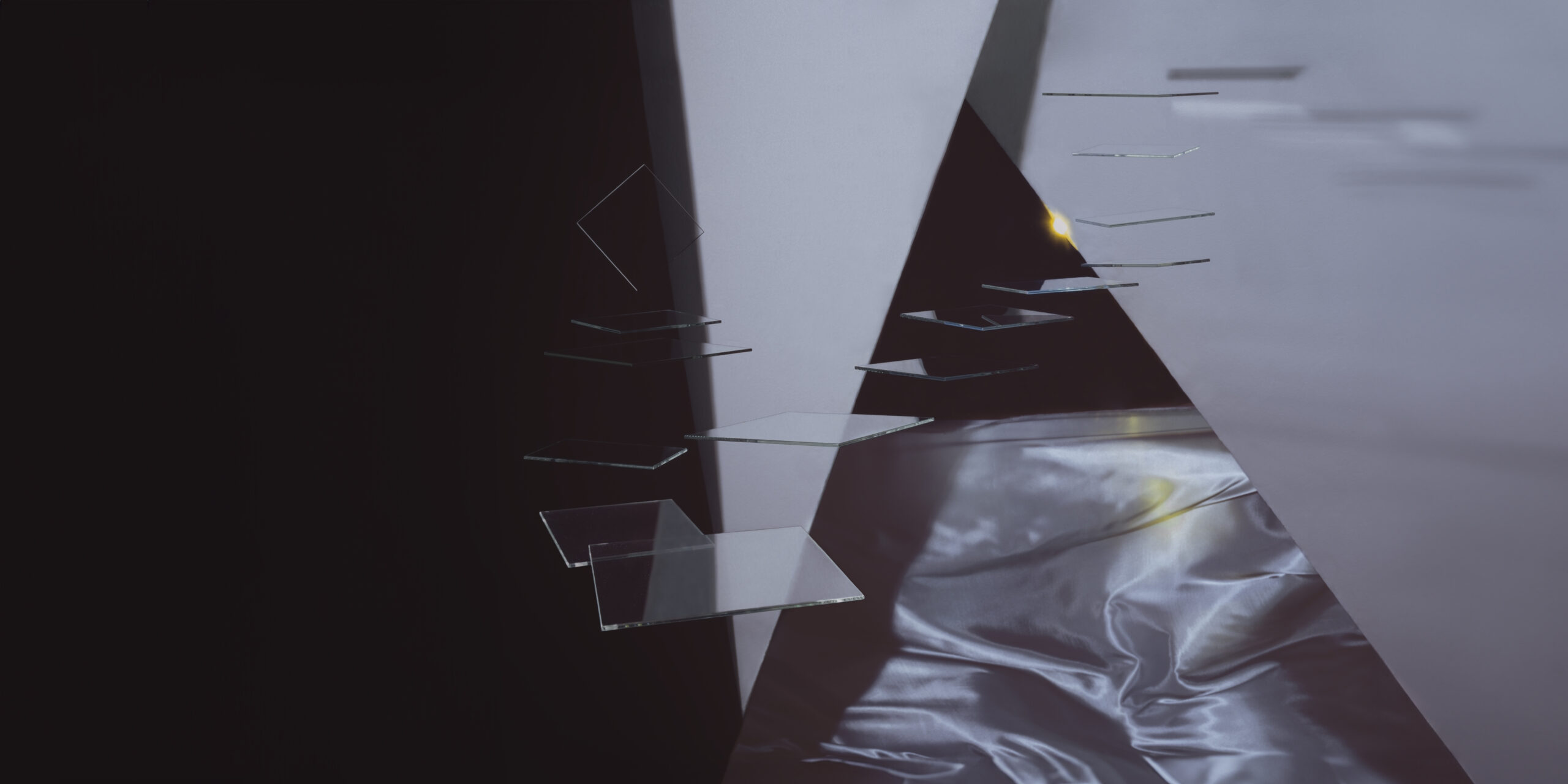
Through abstractions we can void the shackles of the preconceived and talk about conditions solely through metaphor and emotion. Without awe and without terror (2026) is a visualisation of the intermediate state, the place between death and rebirth (or enlightenment) in Buddhistic teachings. At the intersection of cultural identities, this scene of banishment can be concrete and connected to the feeling of never belonging. In the meeting between creator and spectator a new belonging can form, replacing dividing moats with connecting tributaries.
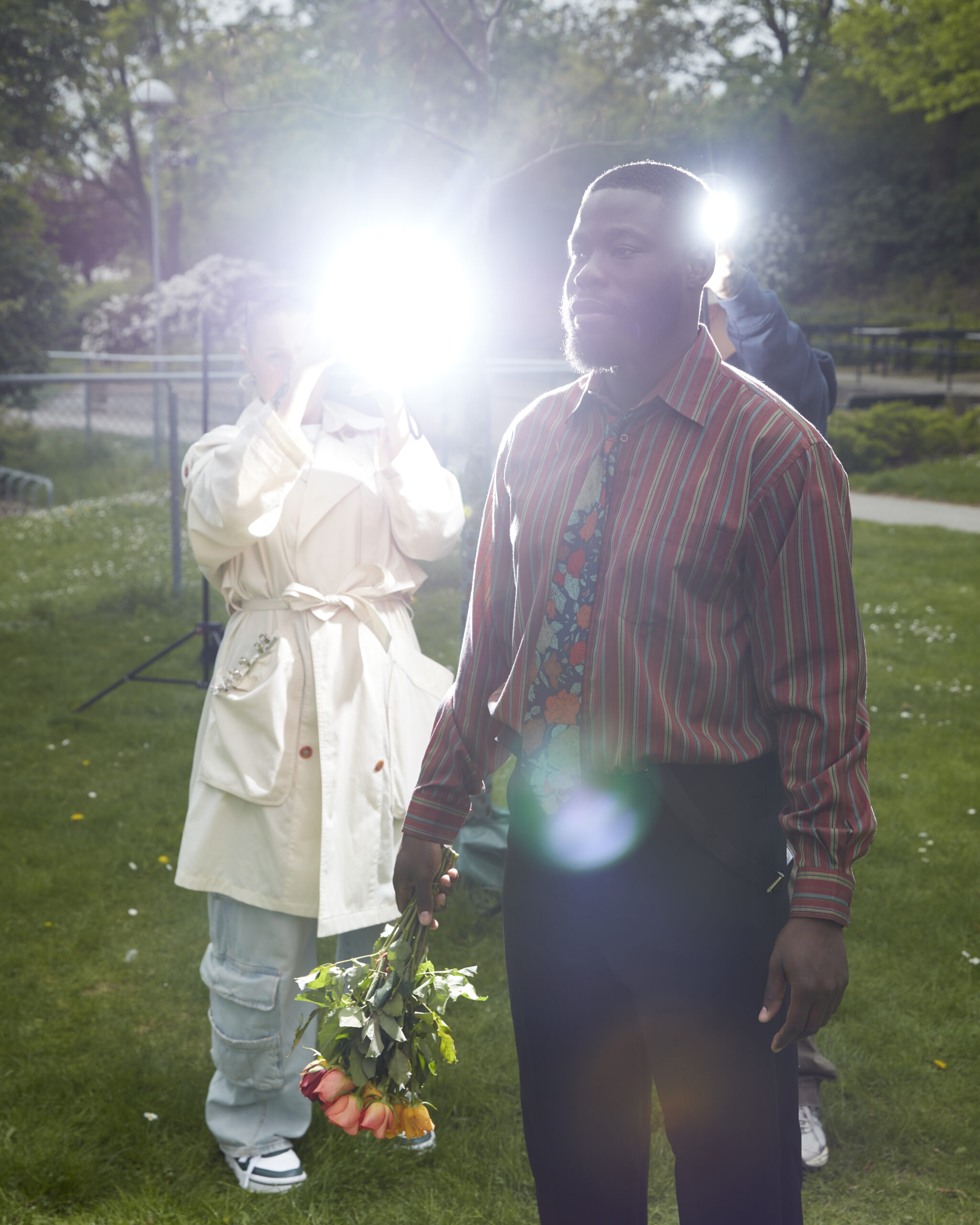
Light and clarity infuse the protagonist with innocence. Steeped in a crown of saintly light – like those coronated in figures made unruly by Basquiat. The title tips the composition into a political gesture – thinking about a climate of increasing volatility and unsafe legal mechanics. The work is created in collaboration with friends and the place where I grew up. A place not so different from Paris’ stigmatized suburbs, the banlieues – the inspiration for Algerian artist, Mohamed Bourouissas works Peripheriqué (2021). A project that inspired the collaborative method used in the creation of Examined (2024).
Engaging the community and immersing us in a world changes the political encounter and puts us closer to understanding the hearts of men. With an important focus on showing marginalized people in the context of culture instead of subculture, the collaborative method presents a community full of rich practitioners of artistic gesticulation and makes reality more levelled. It enables the comprehension of stories deviating from the ubiquity of those told in institutions and art-spheres, and by doing so extends validation to diverse forms of characters and expressions. Identity politics in art doesn’t have to be clumsy and obvious, it can be sharp and allegorical. It can be assembled from a strong idea of identity, that influence decisions and processes that support the visual – enticing the spectators to participate in a pictorial encounter, with the possibility of renegotiating paradigms. The meeting is described by filmmaker and theorist of photography Ariella Azoulay, as an interactive moment between the creator, the subject and the spectator – driving a relationship of responsibility between the participants in the right to see and be seen with ethical responsibility.
“Once, we had painters of modern life; now we have painters of contemporary identities. And it is the fact of those identities—not the way they are expressed—that is understood to give value to our art.” Dean Kissick
Even though our opinions merge on occasions and divide on others, Kissick’s essay nurtured and provoked thought. Rather than disparage the marginalised identity, we can together reflect on the instrumentalization of it. The excavation of identity is a jeopardy for all who wish to wield it. We need to metabolise identity, to fuel form, light and scale to shape a foundation for expression – not a veneer of undigested statements. The belonging or unique quality of character needs to imbue the art that we create, not act in its stead.
The trend of marginalised visibility that we now see has appeared in other industries as a charade to utilise and exploit in the perception of open-mindedness – simply to be discarded when the landscape shifts. There’s opportunity in market trends and if leveraged correctly the marginalised can seize platforms and positions of power that can act dynastically for the empowerment of those otherwise omitted. Maintenance of this influence can only come from sustainable appreciation of value in that which is retained by those called other – the force of condensed vision, undiluted by the general imperative.
Important texts:
https://harpers.org/archive/2024/12/the-painted-protest-dean-kissick-contemporary-art/
https://www.moma.org/magazine/articles/1198
Images:
Fig.1 Without awe and without terror
Fig.2 Examined